

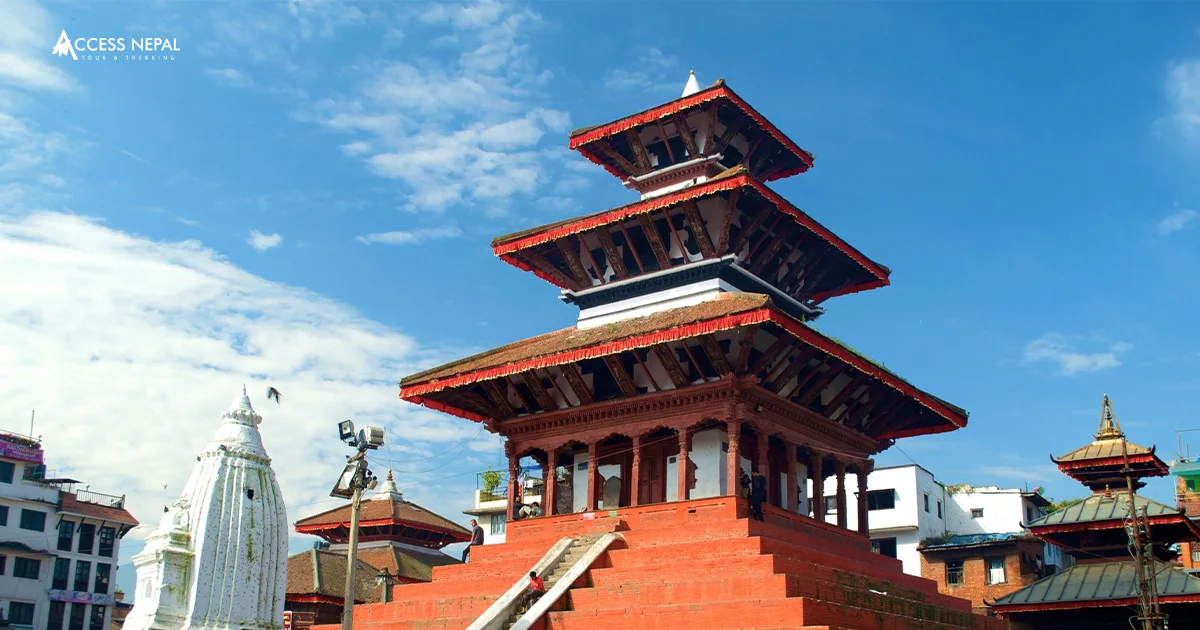
Kathmandu Durbar Square used to be the royal palace of King Prithvi Narayan Shah. Prithvi Narayan Shah once ruled over Nepal and played an important role in the unification of the nation. Nepal was ruled by Malla Kings, and it was named Basantapur Durbar. Kathmandu Durbar Square has quite a large area, so you can spend hours exploring and learning about the history and the art style of the buildings while enjoying the traditions and many other aspects.
Once the statue of Hanuman was brought to Kathmandu Durbar Square. It was referred to as Hanuman Dhoka later. A giant historical structure was created from a single piece of wood in the 12th century, named Kastamandap.
Its name has two meanings: Kasta stands for wood, and Mandap means building or structure. This is how the capital city of Nepal, Kathmandu, got its name. That structure used to serve as a resting place for travelers, but now it is reconstructed and converted into a Hindu temple dedicated to Gorakhnath.
Nepal was popular for its pagoda-style temple, which was later followed by China, Japan, and other Asian countries. Kathmandu Day Tour contains many pagoda-style temples, which were built hundreds of years ago. Once you enter the structure, you have to climb to the top to see the view of the area. You can also find a large stone statue of Garuda, which is also known as the vehicle of the god Vishnu, one of the major attractions for visitors.
The large structure painted white represents the residence of the king from where he used to rule over the nation. But in the current time, it is converted into a museum attached to Gaddi Baithaik, a place constructed by Chandra Samser Rana, one of the prime ministers during the Rana rule, in 1908 AD. It was a place where citizens could interact with a living goddess known as Kumari. Inside the building, you can find several stunning courtyards that exist for different types of royal functions.
The Hindu goddess Taeju, known for sacrificing animals, is also a royal family’s deity. The place is always closed, but in November, during a major temple festival, its doors are opened, and it allows the sacrifice of buffaloes and goats, which attracts hundreds of people during the event.
A living goddess, Kumari, a female who is still a virgin, also known as Talajana, who is worshiped by many people. The king Jaya Prakesh Malla established this living goddess as part of a ritual to bring luck and wealth during the 18th century. After the female completes her menstrual period, she will be replaced by another female to fulfill the role of living goddess.